








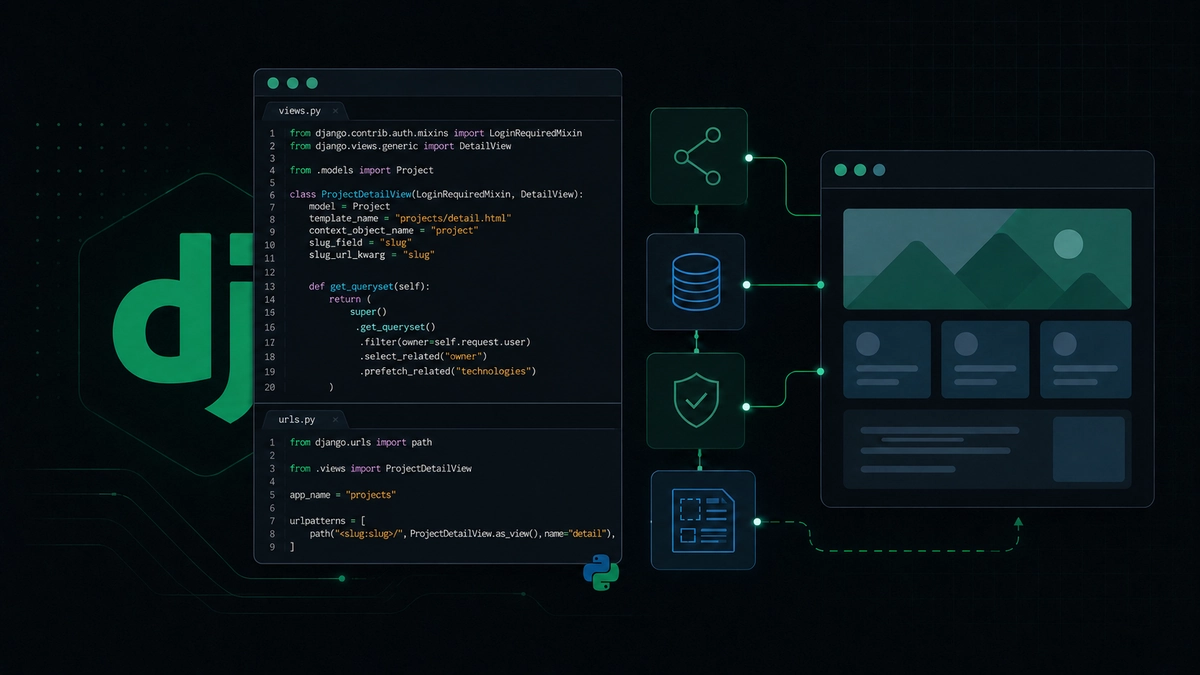
Django is the web framework I reach for when I want to build a real web application without assembling the whole stack myself. It gives me models, database access, forms, authentication, an admin, templates, security tools, and a clear project structure in one place. That means I can spend more time on the actual product and less time connecting basic pieces.
I also like that Django lets me start quickly without forcing me into a throwaway prototype. The same conventions that help me build the first version can keep helping when the project gains more pages, users, workflows, and content. That is the simple reason I love working with Django.
Django gives me a useful starting point
In a JavaScript-first stack, I may need to choose a router, ORM, validation library, admin or dashboard, authentication approach, and frontend strategy before I have built much. That flexibility can be useful, but it also creates decisions and integration work.
Django has opinions. A project has settings, URLs, apps, models, views, templates, forms, and migrations. I can change the details, but I do not have to invent the shape of every project. The result is not magic or zero configuration. It is a solid starting point with parts designed to work together.
That matters most at the beginning of a project. I can create a model, run a migration, add a form, protect a view, and render a page using patterns I already understand. There is less time spent deciding how the pieces should meet, so I get to the useful part sooner.
The built-in features save me from rebuilding basics
The biggest Django advantage for me is not one spectacular feature. It is the number of ordinary problems that already have a sensible answer.
| Django feature | What it saves me from rebuilding |
|---|---|
| Models and migrations | A consistent way to describe data and change the database over time |
| Forms and validation | Repeated field rendering, input cleaning, and error handling |
| Authentication and permissions | The basic pieces for users, sessions, groups, and access rules |
| Django Admin | A private model-based workspace for managing trusted data |
| Templates | A clear way to reuse HTML layouts and render dynamic content |
| Security protections | Common safeguards such as CSRF protection, escaping, and secure defaults |
None of this means I can stop thinking. I still need to design the data, validate important actions on the server, configure deployment carefully, and review permissions. Django gives me strong building blocks, not a guarantee that every application is automatically safe or well designed.
Django documentation: The official overview of Django's models, URL routing, templates, forms, authentication, admin, and other core tools.
One model can power several parts of the app
I try to keep the important concepts in one clear place. A Django model is a good example. It describes the data, but it can also become the shared language between the database layer, forms, admin screens, views, queries, templates, and tests.
That reuse is one of the ways I write less code without making the code feel vague. I do not copy the same field names and validation rules into several unrelated systems. I define the behaviour close to the thing it belongs to, then let the rest of the application use it.
Here is a small example. The model describes a project, and a ModelForm can reuse that model's fields and validation instead of defining them again by hand.
from django import forms
from django.db import models


class Project(models.Model):
    title = models.CharField(max_length=120)
    description = models.TextField()
    is_published = models.BooleanField(default=False)


class ProjectForm(forms.ModelForm):
    class Meta:
        model = Project
        fields = ["title", "description", "is_published"]
The same Project model can be registered in Django Admin, queried in a view, displayed in a template, and covered by tests. I can still add custom rules where the product needs them, but the normal path stays short.
This is what I mean when I say Django helps me write less and better code. Less code is useful when it removes repetition. Better code is useful when the remaining rules are easy to find, test, and change.
Templates keep the frontend close to the product
I like Django templates because they let me work close to HTML. A template can contain normal markup, a few variables, loops, conditions, filters, and reusable pieces. Template inheritance gives me a shared layout, while includes let me keep repeated parts such as headers, cards, forms, and notices in one place.
That is a comfortable middle ground. The page still has a real structure that a browser can receive and a person can inspect, but dynamic values come from the application. I do not need to turn every small interaction into a client-side component just to render a page.
When I need richer interaction, I can add JavaScript or HTMX to that specific part of the page. Django does not stop me from using JavaScript. It simply means I can choose where client-side code adds real value instead of making the entire application depend on it.
{% extends "base.html" %}

{% block content %}
  <section class="projects">
    {% for project in projects %}
      <article class="project-card">
        <h2>{{ project.title }}</h2>
        <p>{{ project.description }}</p>
      </article>
    {% empty %}
      <p>No projects are available yet.</p>
    {% endfor %}
  </section>
{% endblock %}
The template is deliberately not Python embedded into HTML. It has a limited language for presentation, which makes it easier to see what belongs to the page and what belongs in the view or model. That boundary helps me keep templates readable as a project grows.
It also makes reuse practical. If I change the shared layout or a card include, every page that uses it benefits from the same fix. I can keep the visual system consistent without copying a large block of markup across the project.
Django helps me move quickly without making the code disposable
Fast development is not only about typing fewer lines. It is also about making fewer decisions, getting useful feedback quickly, and keeping the next change understandable.
Django supports that workflow with a project structure I can recognise, migrations that describe database changes, management commands for common tasks, an integrated test framework, and checks that catch configuration problems. The pieces are close enough together that I can follow a feature from the URL to the view, model, form, template, and test without jumping between unrelated systems.
The Admin is especially useful during development. Once a model is registered, I have a private way to inspect and manage real data. It is not a replacement for a customer-facing interface, but it can remove a surprising amount of time from internal workflows, content management, and debugging.
- Start with Django's normal project and app conventions
- Put validation and important business rules on the server
- Reuse model fields, forms, querysets, templates, and includes
- Use the Admin for trusted internal workflows instead of building every screen twice
- Add JavaScript only where it makes the user experience better
How Django compares with JavaScript-based stacks
I do not see this as a simple Django versus JavaScript argument. Django is a backend framework, and JavaScript can still be part of a Django application. The more useful comparison is usually a Django application with server-rendered templates versus a JavaScript-first application where the browser owns much more of the interface.
| Django with templates | JavaScript-first stack |
|---|---|
| The server can return complete HTML for a page or form | The browser often requests data and builds more of the interface itself |
| Models, forms, auth, permissions, templates, and Admin come from one connected framework | You can choose from a very large frontend and backend ecosystem |
| A smaller client-side layer is often enough for content and workflow-heavy sites | A rich component model can be a strong fit for highly interactive applications |
| The boundary between server validation and rendered output is straightforward | More client-side state can make the interface feel powerful, but adds another layer to maintain |
JavaScript-first stacks can be an excellent choice. They make sense when the product is primarily a rich browser application, when a team already has a strong JavaScript workflow, or when sharing frontend code across platforms is a major requirement. I would not choose Django just because it is familiar if the product clearly needs a different shape.
There is a trade-off: Django is not right for every project
Django's strengths are clearest when the product has data, users, permissions, forms, content, business rules, and pages that need to work reliably. That covers a lot of websites and web applications, but not everything.
For a browser-first tool built around a canvas, constant live updates, or a large amount of client-side state, a JavaScript-first approach may be more natural. A team that already has a mature frontend platform may also prefer to keep the same approach across its products. Django can still be part of those systems, but it may not be the simplest centre of gravity.
The point is not that Django has no limitations. The point is that its trade-offs fit the kind of work I enjoy building. I prefer a framework that gives me a complete foundation, keeps the main rules on the server, and lets me add complexity only when the product asks for it.
Why Django remains my choice
I use Django because it gives me a productive path from an idea to a working, maintainable web application. I get a clear structure, useful defaults, server-side validation, reusable templates, a capable Admin, and a set of tools that understand the same project.
The biggest benefit is the way those parts reinforce each other. A model can support a form and an Admin screen. A template can reuse the site layout and work with a normal view. Authentication and permissions can protect the same workflows that the rest of the application uses. I write less glue code, and I have fewer places where the same rule can drift apart.
That does not make Django the only good choice. It makes Django a very good choice for the kind of web development I do. When I want to build something useful, keep it understandable, and continue improving it later, Django gives me a foundation I trust.
Frequently asked questions
Is Django only useful for simple websites?
No. Django works well for content-heavy sites, internal tools, booking workflows, dashboards, and many other data-driven applications. The right question is whether its server-centred structure fits the product.
Does Django replace JavaScript?
No. Django can serve the page and handle the application rules while JavaScript or HTMX adds richer interactions where they help. The framework lets me keep that choice local to the interaction.
Does Django's built-in functionality mean I never need third-party packages?
No. I still add packages when a project has a real need for them. Django simply means I start with a connected foundation instead of assembling basic web functionality from unrelated pieces.